Darley Newman on the Frommer's Travel Show: Revolutionary Road Trip and the Hidden History of America's Founding
What does it look like to travel through the American Revolution — not just to the famous battlefields, but to the hidden fortresses, the colonial taverns, the hallowed ground where everyday people made history?
That's exactly what Emmy Award-winning PBS host and author Darley Newman sat down to discuss with Pauline Frommer on the Frommer's Travel Show. In a wide-ranging 34-minute conversation, Darley and Pauline dig into the stories behind Revolutionary Road Trip: Hidden Stories from America's Founding Journey — Darley's debut book published on the occasion of America's 250th anniversary of independence.
The interview is one of the most in-depth conversations Darley has given about the book, covering everything from the Battle of Princeton to the oyster shell fortress hiding in a Charleston park that even locals walk past without knowing it's there.
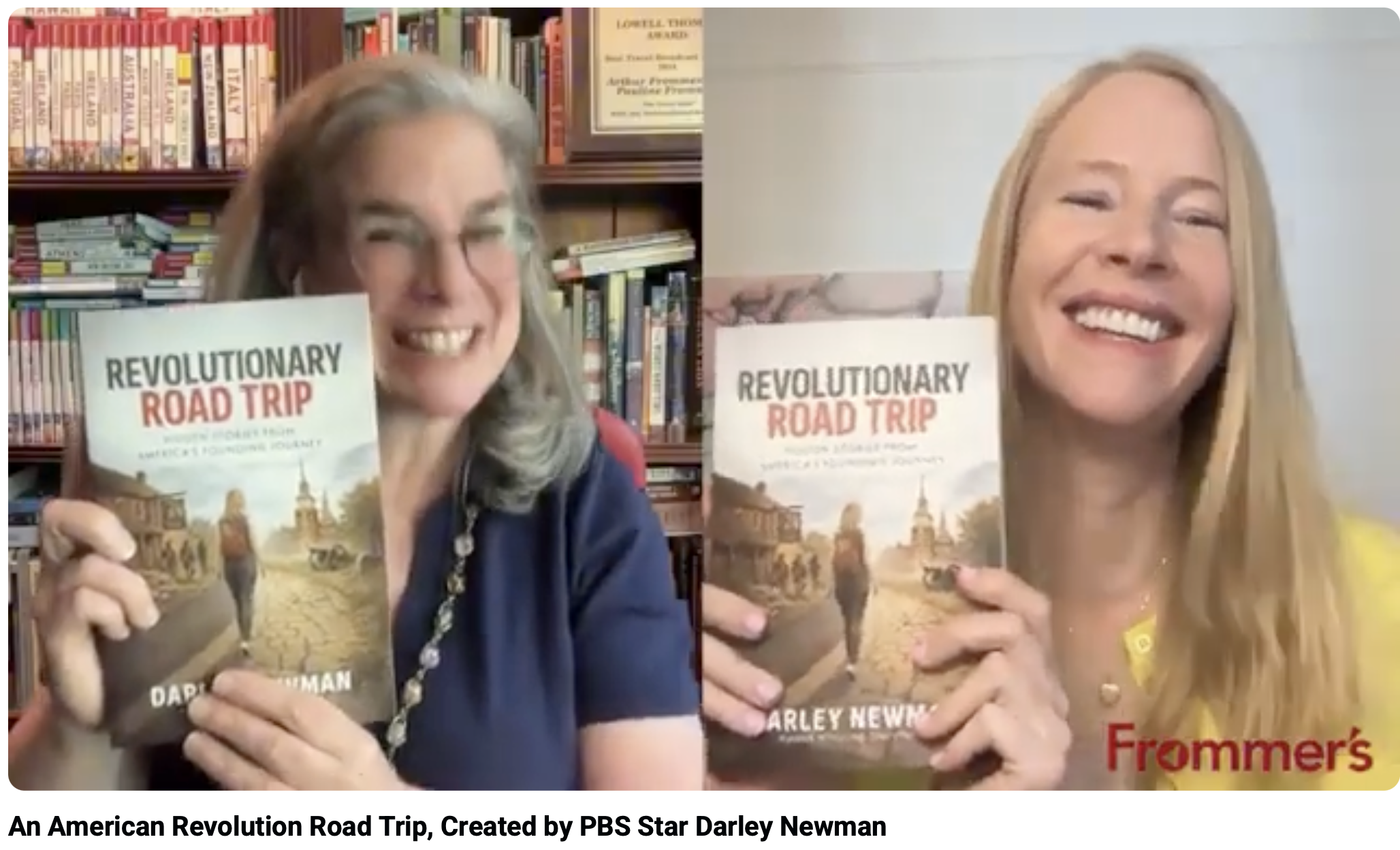
Pauline Frommer and Darley Newman Explore the People, Places, and Stories Behind America's Revolutionary Past
Listen to the Full Interview
The full conversation runs 34 minutes and covers Princeton, Brandywine, the Quaker families of New Jersey, Camden Battlefield in South Carolina, and much more. It's one of the best introductions to Revolutionary Road Trip available — whether you've already read the book or are just discovering it.
What Darley and Pauline Cover in This Episode
Princeton, New Jersey: Alexander Hamilton, Nassau Hall, and a Decapitated King
Darley opens with Princeton — a stop that surprises most people when they hear it's the starting point of a book about the American Revolution. She walks Pauline through the battle fought directly on the campus of what was then the College of New Jersey, the cannon that may have been fired by Alexander Hamilton, and the portrait of King George II that legend says was decapitated by the shot.
She also talks about Mimi of Princeton Tour Company, whose walking tours bring together the Revolutionary era, the story of Einstein in Princeton, and the indigenous history that predates all of it.
For travelers, Darley recommends Princeton Battlefield State Park — a short e-bike ride from the university — where reenactors inside the Clark family home tell the story of a Quaker family whose farm became a hospital for both Continental and British soldiers during the battle.
The Clark Family: A Quaker Farm at the Center of the Revolution
One of the most quietly moving stories in the book is that of Thomas Clark, his family, and an enslaved woman named Susanna — Quakers who refused to choose sides in the revolution, only to have the war arrive literally on their doorstep. Their home became a hospital. Their crops, livestock, and livelihood were taken by both sides. Darley's retelling of this story — and the broader pattern she found repeating at historic homes across all thirteen original colonies — is one of the most powerful threads running through Revolutionary Road Trip.
Charleston, South Carolina: Oyster Shells, the Hornwork, and the Swamp Fox
Charleston gets some of the richest treatment in the podcast — and in the book, which dedicates two full chapters to South Carolina's pivotal and often overlooked role in the American Revolution.
Darley shares the story of the Hornwork — a fortress built from tabby, a concrete-like mixture made from oyster shells, that once stretched across what is today Marion Square in downtown Charleston. Today only a refrigerator-sized remnant survives, surrounded by an iron gate and historical signage, but visitors can trace the outline of the original fortress walls through markers embedded in the park's ground.
And then there's Francis Marion — the Swamp Fox — whose name appears in over 70 places across the United States, and whose guerrilla warfare tactics in the South Carolina backcountry helped turn the tide of the war. Darley traces his story with Keith Gordon, who took her to Marion's grave site, sharing the history of one of the Revolution's most fascinating and undersung figures.
Why This History Belongs to Everyone
One of the most important moments in the interview comes early, when Pauline raises a question Darley hears often: that many Americans don't see themselves in the history of the founding era.
Darley's answer is direct and personal. Her own family came from Sweden and Finland — her father was the first generation born in the United States. But in traveling to these locations, she found women, children, enslaved people, indigenous communities, and immigrants woven through every chapter of the Revolution. The story of America's founding, she argues, is far more diverse — and far more human — than most people realize. And travel is one of the most powerful ways to discover that.
Get the Book
Revolutionary Road Trip: Hidden Stories from America's Founding Journey is available now on Amazon and wherever books are sold.